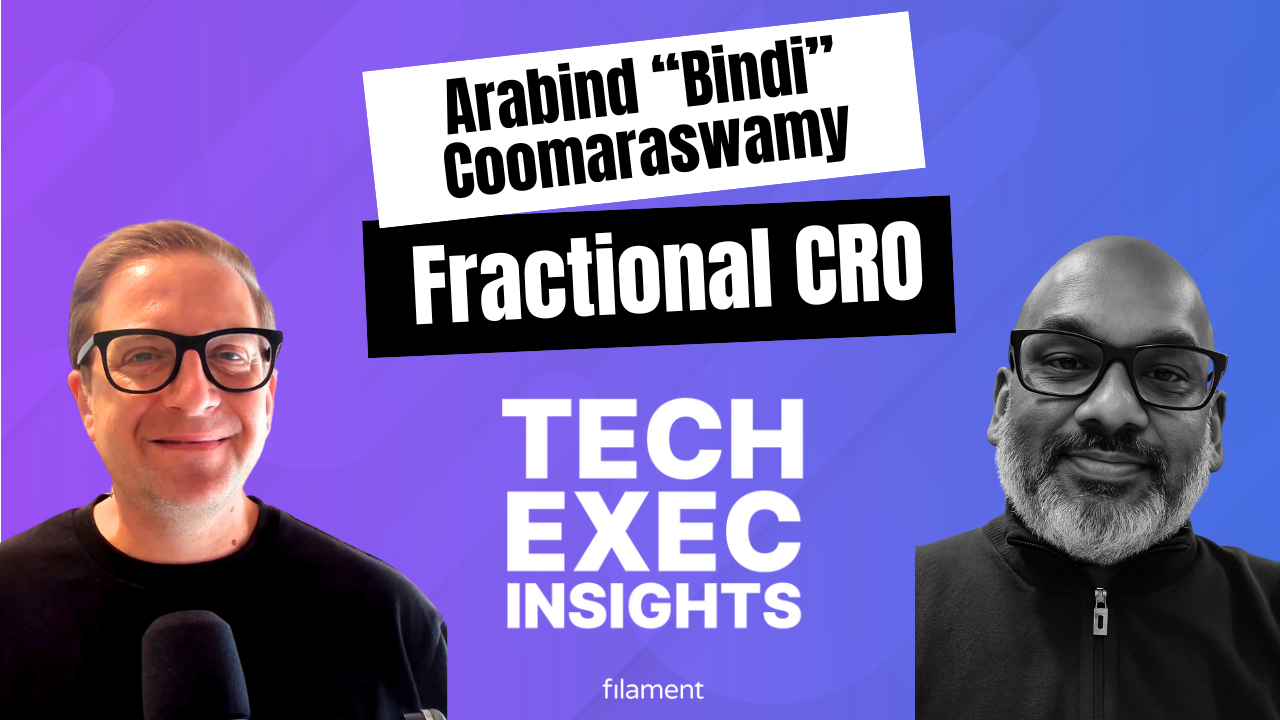
Most founder-led tech teams have a sales problem they did not see coming: the founder. The technology is solid. The service is real. But the person who built the business is also the person blocking it from growing. Arabind Coomaraswamy, Fractional CRO, has spent more than 25 years inside the ecosystems of Microsoft and Salesforce, and now works directly with ISVs and SMBs to fix exactly this. In a recent TechExec Insights conversation, he laid out where founder-led sales breaks down, what it actually means to sell outcomes instead of products, and why the fractional CRO model is gaining ground with scaling tech businesses.
Watch the conversation before reading further. The detail matters.
The Biggest Sales Challenge Is the Founder
Coomaraswamy is direct about this. Founders get in their own way. They are passionate, which is a genuine asset in the early stages, but that same passion makes it hard to hand over control when the business needs a team to take sales forward.
The pattern he sees repeatedly: founders know they want revenue growth but have no clear picture of what needs to happen to get there. They have tried outsourcing to SDR or BDR outfits, been burned, and walked away more cautious than before. What was missing was not effort but structure. As Coomaraswamy put it, defining what success looks like is the easy part. Building the process that gets you there is where most founder-led teams stall.
His restaurant analogy cuts through the noise. A founder trying to do everything, from building the product to running the sales team to managing delivery, is trying to be the head chef, the restaurateur, the sous chef, and the front-of-house staff at once. At some point, the meal suffers. Giving the team space and autonomy is not a loss of control. It is the condition for growth.
Selling Outcomes, Not Products
In a market where dozens of businesses are claiming capability in copilot integration, AI agents, and managed cloud services, capability alone does not differentiate. Every certified partner can say the same thing. The question Coomaraswamy presses founders on is a different one: what business problem does this solve for the customer, and can you frame your entire conversation around that?
When that framing is missing, the sales conversation slides toward price. The customer starts asking for 30 or 40 percent off. That discount feels like a win in the short term, but it repositions the vendor as a body shop rather than a strategic partner. Changing that perception later is hard. Getting the framing right from the start is the work.
He is equally pointed about the menu problem. Founders under revenue pressure tend to add offerings rather than sharpen focus. More services, more technology stacks, more industry verticals. The result is a menu no one can read. His view: a restaurant with six items done exceptionally well will always out-position one with forty items done adequately. Knowing what you are, being specific about it, and charging accordingly is a strategy, not a compromise.
What Enterprise Sales Actually Requires
Selling into enterprise is a longer game than most ISVs are prepared for. Coomaraswamy uses Westpac as a concrete example: getting onto the panel alone can take 12 to 18 months. The backend work, including documentation, security posture, industry specialisation, and delivery track record, has to be in place before the conversation with a large enterprise can go anywhere useful.
What he sees boutique and emerging tech firms get right, when they get it right, is speed and specificity. Enterprise dev teams are large and expensive. A smaller, specialist firm that already understands the industry, already has a solution running, and can deliver a defined outcome in weeks rather than months is offering something a large SI cannot. That is the pitch. But it only works if the preparation is there. Walking in without it, and expecting to build credibility on the fly, does not land.
When a Fractional CRO Makes More Sense Than a Full-Time Hire
A full-time CRO costs somewhere between 250,000 and 500,000 dollars a year, fully loaded. For an ISV still building its go-to-market motion, that cost does not match the stage of the business. Coomaraswamy draws the comparison to cloud infrastructure: you do not need servers running 24 hours a day if your actual usage is variable. The same logic applies to revenue leadership.
What a fractional CRO brings is the strategy, the vendor relationships, the go-to-market architecture, and the ability to build the mechanisms that a full team will eventually run. The founder gets direction and support without the payroll commitment. When revenue grows to the point that full-time presence is warranted, the foundation is already there.
His first question to any CEO who calls is not about revenue targets. It is about purpose: why are you in this, and what does success actually look like for you? That conversation shapes everything that follows, including whether the assumptions behind the current growth plan need to be tested before any new mechanism is built.
Where Positioning and Revenue Strategy Connect
The gap Coomaraswamy describes, between having a strong technical offering and being able to articulate its value to a buyer, is also a marketing and positioning problem. B2B tech firms that cannot explain what they solve, for whom, and why it matters will struggle to convert in any channel. Filament works with technology organisations to close exactly that gap: building the messaging, content, and market presence that supports a sales function rather than working against it.
[LINK: relevant Filament service or capability page]
Talk to Jeremy Balius
If your tech business is founder-led and you are trying to figure out what the next phase of growth actually requires, Jeremy Balius works with B2B technology organisations to build the strategy and content infrastructure that supports scale. No obligation, no pitch. Just a direct conversation about where you are and what might need to shift.
[LINK: Book a strategy conversation with Jeremy]