

Your best client work is sitting in a project folder. Somebody delivered it, the client was pleased, and nobody wrote it down.
That is where most B2B technology companies sit. They have the proof, but they do not have the asset.
That gap costs them deals they never see. A buyer builds a shortlist, asks three suppliers to show they have solved this before, and quietly drops the one that cannot.
This step by step guide covers how to write B2B case studies your sales team will actually use. How to pick the story, what structure to follow, what to do when the client will not release numbers, and how to make the finished page work in AI search as well as Google.
Why case studies carry the weight in a B2B deal
The buying group reads you without telling you
Gartner’s research on B2B buying puts the typical group for a complex solution at six to ten decision makers. Those buyers spend roughly 17% of their total purchase time meeting suppliers. When several suppliers compete, any one of you gets 5% to 6%.
The rest happens without you. Case studies influence 67% of B2B purchasing decisions before first contact. People read them on your company website, forward, argue and rank you while you are not in the room.
A case study is one of the few assets that works inside that decision making process. It gets forwarded. It gets quoted back to you with more detailed follow up questions.
Your proof gets summarised by machines
B2B buyers including your target audience now ask ChatGPT, Perplexity, Claude, CoPilot and Google’s AI Overviews who solves a given problem in a given industry. Those systems read your case studies and summarise them for the buyer.
A case study written as loose narrative with vague claims gives them nothing to work with. One built on clear, attributable facts from actual clients and gives them something to cite.
The real problem is throughput, not writing
Most companies already know what a good case study looks like. They still do not have any. The bottleneck sits earlier than the writing.
Your best people are on revenue work
The subject matter experts who hold the detail are billable. Every hour spent reconstructing a project is an hour off client delivery. Case studies lose that argument every quarter, and the backlog grows.
Nobody owns the sign-off
Drafts move from the account lead to legal to the client and back. Without one named owner holding a deadline, the cycle drifts until the project is too old to be worth publishing.
The framework changes every time
When each writer invents the structure, quality swings from story to story. The sales team loses confidence in the library and stops reaching for it. Then the case for investing in more of them collapses.
Fix the framework once and the throughput problem shrinks. That is the practical argument for standardising before you write a single word.
Choosing which client story to build
Selection matters more than craft. A beautifully written story about the wrong client is still the wrong story. Compelling case studies are a crucial aspect of social proof, build credibility and form an early emotional connection for your target audience.
Recency
Work finished in the last 12 to 24 months. Older than that and buyers discount the technology, the market conditions, or both. LLMs may not surface or weight older case studies in their recommendations.
A measurable change
Something moved and there are relevant metrics to substantiate. Cost, cycle time, pipeline, headcount avoided, risk removed. A client who says they were pleased has not given you a case study.
The client you want more of
Pick the engagement that looks like the work you want next year. A large logo attached to an irrelevant use case is worth less than a mid-market client whose situation mirrors your target buyer.
Willingness to participate
Some clients will not appear in public at any price. Regulated industries, competitive sensitivities, a legal team with a standing policy. Find out before you build a content plan around them.
Keep a running shortlist
Ask sales, delivery and account management to help identify the most compelling case studies by nominating candidates each quarter. Record the challenge, the outcome and the client contact. That habit is what stops the scramble when a campaign needs proof in a fortnight.
Decide the commercial intent before you write
Name the sales motion the story has to serve
Is this story for a buyer still deciding whether the problem is worth solving? Or for one at the shortlist stage who needs to justify you internally? The answer changes the structure, the length and how much detail belongs in the solution section.
A story with no stated job tends to serve none of them.
Write for the target audience, not one persona
Most guidance tells you to choose a single buyer persona and write everything for them as the reader.
Gartner research published in May 2025 complicates that. Personalising content to individual members of a buying committee harmed group consensus by 59%.
For a case study, that means moving away from narrow persona targeting and treating the whole buying committee as the target audience. Write something the champion can forward to the CFO or other decision makers without having to translate it first.
Settle the naming question early
Named client, anonymised profile, or named client with indexed figures. Agree this at the start, not at the review stage. Most delays in case study production come from litigating it late.
A B2B case study framework: Example
This is the structure Filament applies. Every section answers a question the buyer is already asking.
Here’s an overview of the framework we use in our B2B case study methodology and approach.
|
Section |
What it does |
The buyer question it answers |
|
Title |
Names the client and the headline outcome |
Is this relevant to me? |
|
Introduction |
Executive summary of the engagement |
Do I need to read the rest? |
|
About the client |
Industry, offering, market, scale |
Is this company like mine? |
|
The challenge |
Why they went looking for help |
Do I have this problem? |
|
The engagement |
How they found you and why they chose you |
Why this supplier over others? |
|
The solution |
What you delivered and how |
What would actually happen? |
|
The benefit |
The value delivered, stated explicitly |
What is this worth? |
|
The result |
The outcome of the engagement |
Did it work? |
|
Call to action |
Where the reader goes next |
What do I do now? |
Here’s each case study section explained.
1. Title
The client name and the outcome. Nothing else. If the result is strong, lead with concrete numbers rather than the company, since titles using them can achieve up to 45% higher click rates.
2. Introduction
Three or four sentences carrying the whole story. Surface measurable results early so even a quick read captures the impact. Many readers stop here, which is fine provided they leave with the right impression. Keep this section easily scannable for busy readers.
3. About your client
Include industry, what they sell, who they sell it to, and their scale. This is where the reader decides whether the story is about someone like them, so give them enough to make that call. Keep the customer as the hero of the story, not your company. 72% of B2B decision-makers prefer customer-focused success stories.
4. The challenge
The business problem, not the technical symptom. What was it costing them to leave it alone, and what made it urgent enough to act on?
5. The engagement
How the client found you, what they assessed, and why they chose you over the alternatives on their list. More on why this one matters below.
6. The solution
What you delivered, plus the process and methodology behind it. Describe the work you did, not your product catalogue.
7. The benefit
The value the client received, stated plainly. Keep it separate from the result. The benefit is what changed for them. The result is the number attached to it.
8. The result
The outcome, quantified where you can and characterised honestly where you cannot. A precise description of a real change beats a vague percentage. In the results section, visual elements such as charts or simple graphics can make key statistics more digestible.
9. Call to action
One next step, matched to where the reader has landed. A demo, a discovery call, or a related story for someone who is not ready to talk yet.
The engagement section is the one everybody skips
Read most published B2B case studies and you will find the same sequence: challenge, solution, result. The evaluation disappears entirely.
That is a mistake, because the evaluation is exactly where your reader is standing. They have a shortlist. They are building an internal case for one name on it. They want to know what somebody in their position weighed up, and why that person landed where they did. The same story can also work as educational content for potential customers earlier in the sales process, then help justify the final choice later.
Writing this section forces a useful conversation with your client. What else did you look at? What nearly stopped you choosing us? Who was sceptical, and what changed their mind?
The answers are usually more interesting than anything in the solution section. They are also the part a champion can quote directly when they are defending the decision to a committee that was not in the original conversation.
If you only add one thing to your existing case study template, add this.
The fact panel most case studies leave out
Put a structured panel near the top of the page: industry, company type, offering, target market, vendor relationships, technologies used and the services you delivered. Internal linking to relevant pages on your website is recommended.
There are two reasons. A skim reader qualifies the story in about four seconds. An AI system reading the page gets clean, extractable facts rather than having to infer them from prose.
What to do when the client will not release the numbers
This is the most common reason case studies stall, and it is solvable. Work down the ladder until you reach a level the client will approve.
Named client, named numbers
The client agrees to publish the figures alongside their name. The strongest position available, but the customer data cannot tell a negative story about your client. Ensure the case study cites numbers that focus on the positive outcomes.
Named client, indexed numbers
Percentages, multiples and ranges instead of absolute values. Three times the qualified pipeline, without disclosing the baseline that would let a competitor reverse engineer their revenue.
Named client, operational proof
Describe what changed in how the business runs. A process that took three days now takes two hours. A team that stopped doing something manually. No commercial figures involved and often an easier approval.
Anonymised profile, real detail
Name the industry, size and market precisely, and remove the company name. Say openly that the client is anonymised and why. Readers accept that far more readily than a vague story pretending to be specific.
One approach to avoid is the composite: several projects merged into a single invented client. Readers can sense it, and it’s less impactful.
Running the client interview
Book 30 minutes as a deliberate target to gather customer experiences efficiently. Send the questions in advance. Record it with permission and have it transcribed.
Ask about the situation before the project, what they tried first, who else they assessed, what the decision came down to, and what is different in their working week now.
Do not interview the marketing contact. Interview the person who owned the problem. They will tell you things the marketing contact has already smoothed over.
Pull the strongest direct quotes from the transcript rather than paraphrasing from memory, and attribute them with a name and a role. An unattributed quote carries almost no weight with a technical buyer.
If the client is senior, have someone senior run the interview. A junior writer asking an executive about a procurement decision tends to get the polite version.
How long should a B2B case study be
Length follows the job, not a template. The word count numbers people quote for this vary wildly because they are either answering different questions or stating practical common denominator lengths.
A story that has to carry a shortlist decision needs room for the engagement section and the detail behind the result. Somewhere between 1,200 and 2,000 words on the page.
A story that exists to open a conversation for sales enablement can run 600 to 800 words. A sales one-pager is shorter again, and mostly visual.
Write the long version first. Everything else in your content marketing can leverage form the long version.
Writing so AI search can use the story
Answer first in every section
Open each section with the claim and put the explanation underneath. Generative systems extract the first clear statement they find under a heading, so bury the point and you will not be quoted.
Keep the facts extractable
Specific numbers, dated and attributed. Client name, industry, product names, timeframes. Writing that hedges everything gets skipped in favour of a competitor who committed to a claim.
Add schema and an FAQ block
Mark up the page so machines can parse the organisations, the article and the questions. An FAQ block covering what buyers in that industry actually ask gives you more surfaces to be cited from.
Do not gate the case study
A gated case study cannot be crawled, cannot be cited, and cannot be forwarded inside a buying group. Publish the story and gate a deeper version if you want the lead capture.
Mistakes that detract from an otherwise good story
Aim to avoid these common mistakes in your B2B case study writing.
A promotional tone
If the page reads like an advertisement, the reader discounts everything in it, including the numbers you worked hardest to get approved.
Skipping the challenge
Without the before, the after has no weight. A result with no starting point is just a figure.
Feature stuffing
Listing every capability you deployed dilutes the two or three that actually mattered to the outcome.
Vague company profiles
If a reader cannot work out what kind of business this was, they cannot place themselves in the story.
Statistics nobody can trace
Unsourced percentages are common enough in marketing content now that buyers ignore them. Every number should survive being checked.
Letting the library go stale
Review the portfolio annually and retire anything that no longer reflects how you work.
The framework in practice
To see this structure in action, refer to our own case study, developed to tell a GTM story about our work with FUJIFILM CodeBlue.
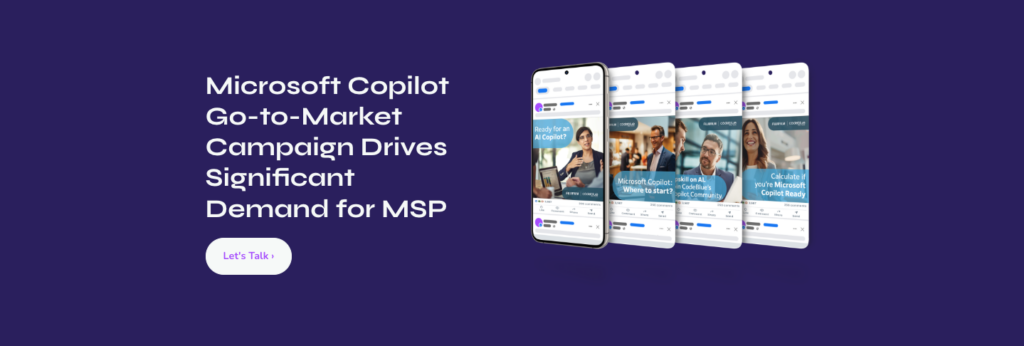
The About section establishes FUJIFILM CodeBlue
The About section establishes CodeBlue as one of New Zealand’s largest managed service providers, with a fact panel carrying industry, offering, target market and vendor channels.

The Challenge involved taking Microsoft Copilot services to an SMB market
The Challenge covers taking Microsoft Copilot services to an SMB market that did not yet understand what Copilot was for.

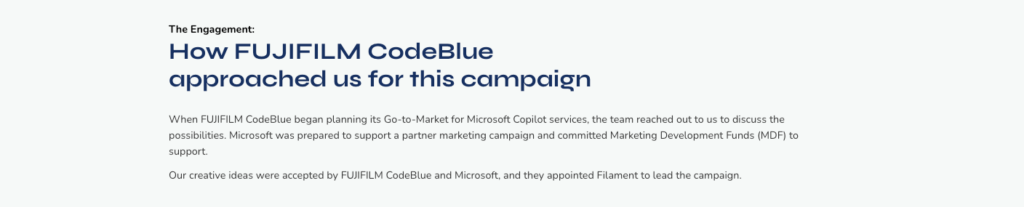
The Engagement section shows how FUJIFILM CodeBlue approached Filament
The Engagement section explains how CodeBlue approached Filament, that Microsoft committed marketing development funds to support a partner campaign, and that the creative approach was accepted by both parties before Filament was appointed.
That paragraph is where a reader in a comparable position stops. It tells them how a buyer like them ran the decision, which is the one thing a challenge-solution-result structure never explains.
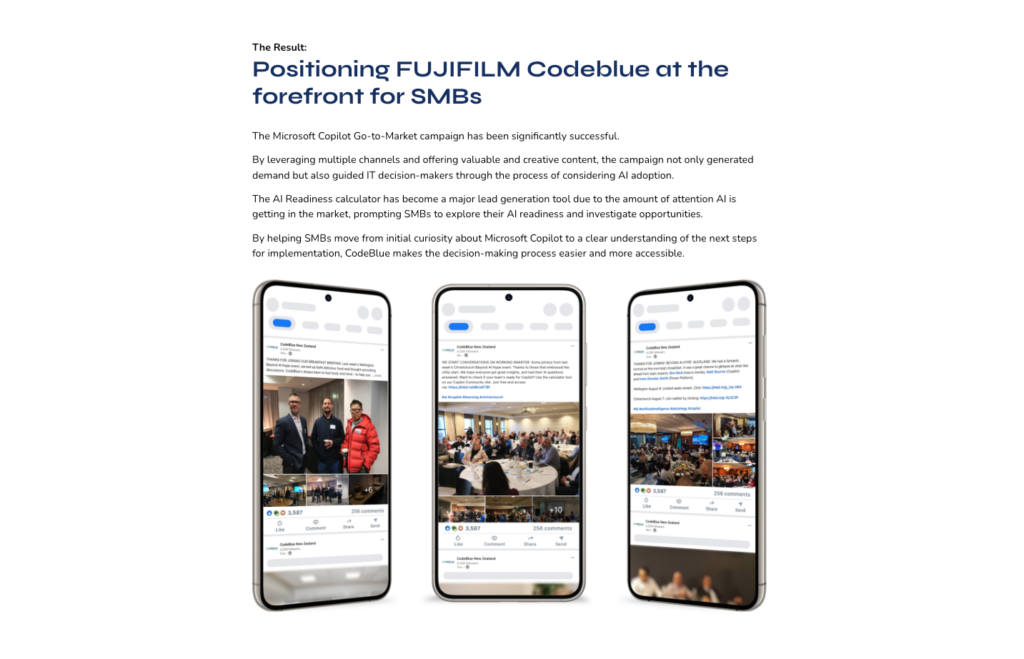
The Solution and Benefit sections outline the GTM campaign
The Solution and Benefit sections cover the campaign itself, including a Copilot readiness calculator built by integrating four platforms, which became a significant lead source for the business.

The Result section closes on market position
Finally, the Result section closes on market position rather than on a figure. The campaign moved SMB IT decision makers from curiosity about Copilot to a clear view of what adoption would actually involve, and the readiness calculator became a primary lead source off the back of that shift.
Note what is absent. No revenue number, no percentage, no pipeline figure.
That’s because in this instance, operational proof is the key message, describing what changed in how the business runs and how its buyers behave, with no commercial figures involved. FUJIFILM CodeBlue’s numbers are their own. The story still works because the outcome is specific about what the calculator does, who it reaches and other overall benefits and outcomes delivered by the GTM campaign.
Getting more out of a finished case study
One interview can carry a lot more than one URL.
Give sales a one-page version and a slide for the pitch deck. If your reps have to search the website mid-conversation, the story does not get used.
If the interview was filmed, short clips carry further on LinkedIn than the written story does. Where a client will not appear on camera, an animated version covering the same points works as a substitute.
Then link it into the rest of the site, from the relevant service and industry pages and from related stories. Organise the library by problem rather than by client name, because that is how a prospect looks for it.
Ready to turn your delivered work into proof that sells?
Filament builds B2B case studies as go-to-market assets for technology vendors, MSPs, SaaS companies and channel businesses. We run the framework, the interviews, the writing and the production. You make the client introduction and approve the copy.
Prefer to talk about your B2B case studies now?
It’s easy to get started: you’ll speak with a B2B tech marketing strategist one-on-one, and by talking through your goals you can discover priorities quickly, re-align tactics or identify low-hanging fruit. No sales pitch, no obligation, just strategy.
How to write B2B case studies Frequently asked questions
How do I get a client to agree to a case study?
Ask at the point of success rather than months later. Frame it as a feature about their business rather than a case study about yours, with concrete benefits like added publicity for their team. Keep the time commitment under an hour and handle every part of the scheduling yourself.
How many case studies does a B2B company need?
Enough to cover the industries, use cases and deal sizes your sales team actually meets. Four to eight strong stories beat twenty thin ones. Expand where reps keep getting asked for proof you do not have.
Can we reuse a case study across regions?
Adapt rather than translate. Currency, regulation and the competitive set all shift. A story that lands in Australia may need reframing for a European buyer facing a different compliance picture.
How often should case studies be refreshed?
Review the strongest performers every 12 months. Refresh the figures or add a later phase of the work. A four-year-old story with no update undermines the credibility you are trying to build.
Who should write them, internally or externally?
Internal teams know the detail but rarely have capacity, and clients tend to speak more candidly to someone outside the commercial relationship. Either way, fix the framework and the owner in advance.