
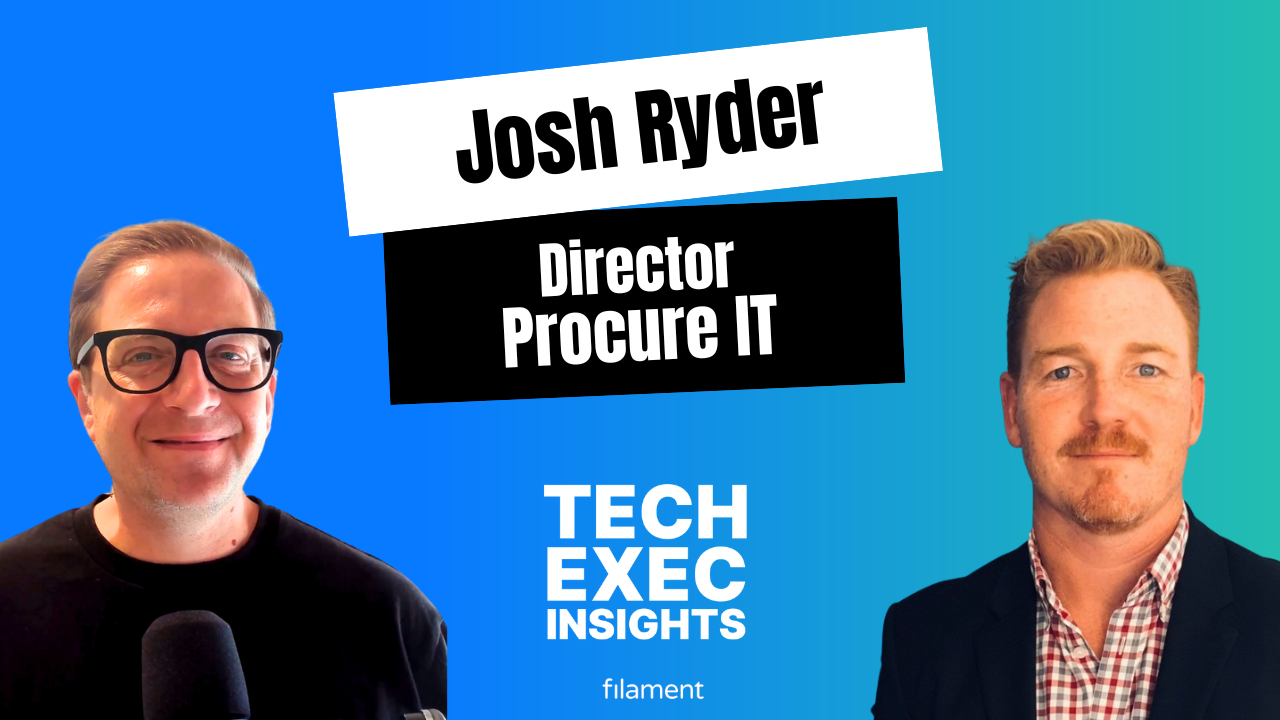
Introducing Josh Ryder and Procure IT
Most organisations believe they have a handle on IT procurement. They don’t.
The .6 million in annual savings that Josh Ryder regularly uncovers for clients didn’t appear in a single line item. It accumulated quietly across disconnected departments, forgotten SaaS licences, evergreen contract clauses, and cloud resources nobody turned off.
Ryder is a Director of Procure IT, a managed intelligence platform built to give technology leaders visibility into what they’re actually spending and why it keeps blowing out. Before you read further, watch the conversation first.
Procure IT is a managed intelligence platform serving businesses from mid-market to Fortune 500. The platform consolidates vendor contracts, SaaS licences, cloud spend, and technology expense management into a single live view, then applies AI to surface the specific decisions that need to be made. Clients span verticals including financial services, retail, hospitality, and the MSP channel. The company was recently named to the CRN Stellar Startup list.
Watch the full Tech Exec Insights conversation
The IT Spend Problem Nobody Is Solving Correctly
The core problem in IT procurement is not technical. It is structural. In most organisations, multiple stakeholders are making technology decisions in parallel, each optimising for their own team’s needs without reference to what the rest of the business is already running.
Ryder describes this as the cost of shortsighted decision-making: “They make a short term decision that really impacts them in the long term. Always negatively.” The result is siloed technology stacks that cannot communicate across departments, compounding spend that nobody has mapped end to end, and a CFO who is demanding visibility that no one can provide.
The problem is not unique to large enterprises. For mid-market businesses, the IT manager is wearing every hat simultaneously. New employees get provisioned. Departing employees do not get deprovisioned. Licences accumulate. Invoices get processed without interrogation because the accounting team does not have capacity to audit them. The spending keeps building, and nobody has the full picture.
What Managed Intelligence Actually Means
Many platforms give organisations information. Procure IT’s argument is that information stored in cold storage is not the same as intelligence that drives decisions.
The starting point is always contracts. Ryder’s team ingests every vendor contract, no matter where it is stored, and brings it into a live Gantt-style view that shows renewal dates, auto-renew clauses, benchmark pricing, and vendor health signals including share price movements and cyber breach disclosures. A client who believes their contracts are managed in ServiceNow is often surprised to learn that “cold storage” is not the same as active intelligence.
From contracts, the platform moves into SaaS, cloud, and technology expense management. One client was confident their SaaS budget of 4,000 per month was well managed. Within 10 days of a proof of concept, Procure IT identified ,400 per month in unused licences, a situation that had persisted for nearly two years.
Ryder’s point on cloud is equally direct. Procure IT opens the cloud storage monitor, clicks wastage, and a savings number appears. “Unfortunately it is real,” he says. “But we can stop the bleeding now.”
The Numbers: What Visibility Consistently Turns Up
At the proof of concept stage, which Procure IT runs at no cost, the team works from contracts, licence data, and HR records at a high level. The baseline finding, across every engagement, is 15 to 30 per cent in savings against current spend.
For MSPs, the numbers are often higher. Managing 100-plus vendors across complex environments without dedicated software means manual reconciliation that consumes more in staff time than a managed intelligence platform would cost. Ryder is direct about this: the cost of doing nothing, or doing it manually, exceeds the cost of the platform.
For CFOs and CEOs who say they have no budget for new tooling, Ryder’s response is consistent: “We don’t have budget. Let us create budget for you out of the money that you’re overspending on things that you aren’t using.”
Where to Start if You Have No Idea Where to Start
Ryder’s advice to any CEO trying to get IT spend under control is unambiguous: start with contracts. Every time. Understanding who you are contracted to, for what terms, for how long, and at what amount gives you the first clear view of where the budget is and why it is blowing out.
He also flags Australian regulatory context. CPS 230, legislation coming into effect in July, requires financial services businesses to have a managed contract system with visibility over third-party relationships and spend. Organisations that have been managing contracts on spreadsheets or across SharePoint folders are already behind.
The practical output of contract visibility is a board-ready view: total vendors, total contracted spend, actual spend, and the gap between them. That gap is where the decisions live.
What This Means for B2B Technology Organisations
The conversation with Ryder surfaces a pattern Filament sees consistently in B2B technology marketing: organisations with strong products and genuine ROI struggle to communicate the problem clearly enough for buyers to act. Managed intelligence is a category that solves a real and measurable problem, but articulating that to a CFO or CEO who believes they already have control requires precise, evidence-led messaging. That is where positioning and content strategy become operationally important.
Filament works with B2B technology organisations to build the kind of content that makes that case clearly.
Ready to discuss your Go-to-Market?
If your organisation is navigating a technology marketing challenge, whether that is repositioning a product, building a content engine, or reaching a new buyer segment, a short strategy conversation can clarify the path.
Book a no-obligation GTM strategy conversation today.