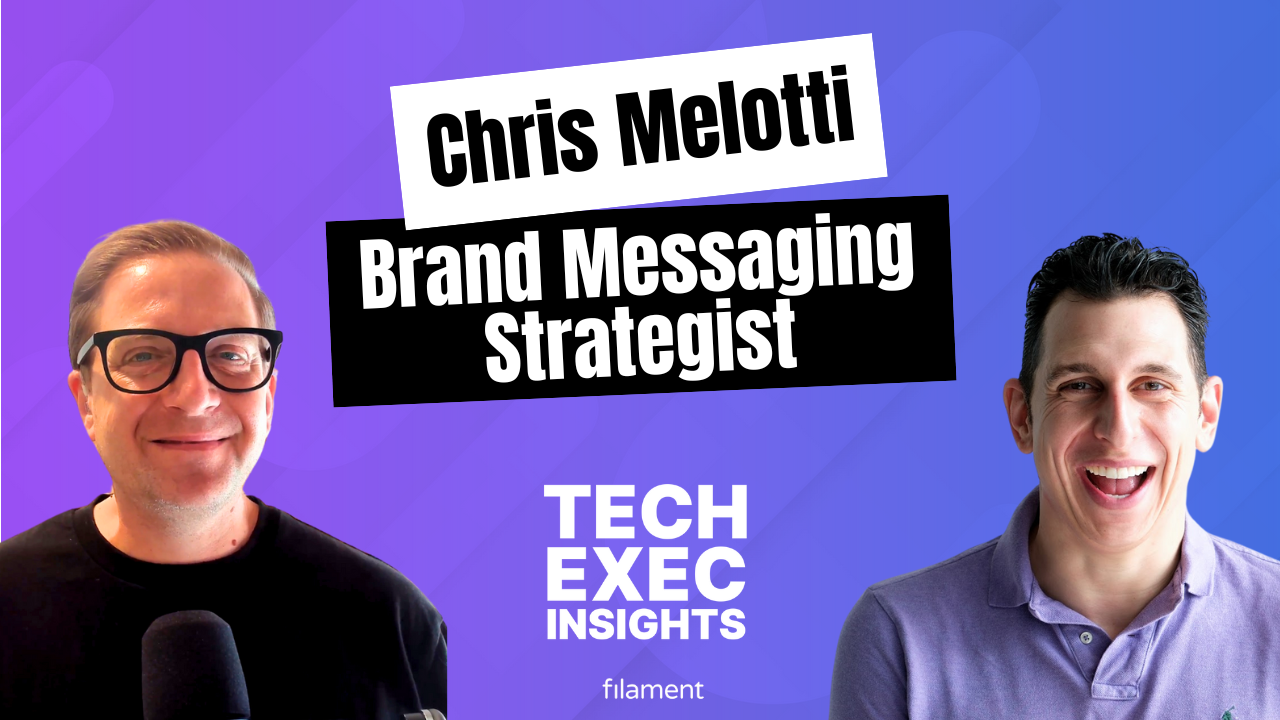
Introducing Christopher Melotti
Corporate marketing has never been enough on its own. But for technology executives, the gap between what a company says and what its leaders say publicly is becoming a credibility problem. Christopher Melotti, Brand Messaging Strategist, has spent years helping executives figure out how to show up on LinkedIn in a way that builds genuine authority rather than just noise. His position is clear: personal brands are now the most powerful sales and trust-building tool available to a senior leader. Watch the full conversation before reading further.
Watch the full Tech Exec Insights conversation
Why “too polished” is a problem
Most executives assume that showing up online means producing something pristine.
Melotti argues the opposite. That middle ground between raw and overproduced is exactly where trust forms. “That slight imperfection is what people love, because there’s a sense of trust around it.”
Audiences are not looking for a corporate broadcast. They are looking for a person. When content looks like it was produced by a committee, it reads like it was produced by a committee.
This matters for technology leaders in particular. B2B buyers are sceptical. They do their research.
A LinkedIn presence that feels managed and sanitised does not help a deal progress. A leader who speaks plainly about what they know does.
The time problem is mostly a planning problem
“I’m time poor” is the most common objection Melotti encounters.
His response is to reframe the whole activity. Rather than carving out dedicated content time, he advises executives to identify moments in their existing schedule that already carry proof points: a conference appearance, a team workshop, a client conversation.
One photo or short clip from each of those moments, posted with intention, builds a presence over time without adding a second job.
The key phrase is “with intention.” Melotti’s point is not that volume drives results. It is that each post should connect to the professional identity the executive wants to build.
A patchwork of disconnected posts adds up to noise. A patchwork built around a consistent perspective adds up to authority.
Opinion Is the one thing AI cannot supply
In a conversation that touched on AI more than once, Melotti made a specific distinction worth holding onto.
The executives who stand out are the ones sharing views and expertise that only they can offer. “The best thought leadership is the stuff that only you know and can answer.”
Key opinion leadership, as he frames it, means people are looking for a perspective, not just information.
This is where many LinkedIn strategies fall apart. Leaders default to sharing industry news or reposting company content. That positions them as an aggregator, not an authority.
The audience already has access to the same information. What they cannot get anywhere else is that particular leader’s read on it.
Where AI use becomes a credibility risk
Melotti is not anti-AI. He is specific about where it goes wrong.
Using AI to generate content that misrepresents the executive’s actual experience, or fabricates insights they do not hold, creates a trust problem that is hard to recover from. “You don’t stay unseen for long. People find out.”
An audience that discovers inauthenticity does not get angry. They just leave. And on a platform with as much content as LinkedIn, they have no reason to come back.
The standard he sets is straightforward: AI can support the process, but the experience, the opinion, and the voice have to be real.
Storytelling With a Point
One of the more practical frameworks Melotti offers is the two concentric circles model for storytelling.
One circle is what the executive finds interesting. The other is what the audience finds relevant. The overlap is where content should live.
Stories told outside that overlap, where the executive is processing something personal that has no relevance to the audience, tend to erode a following rather than build one.
A good story on LinkedIn has a hook, a specific insight, and a point the reader can take somewhere.
Without that structure, the post becomes noise that people learn to scroll past.
Building visibility into a content strategy
Many B2B technology organisations invest heavily in company-level content while their senior leaders remain largely invisible online. Filament works with technology companies on the full content picture, and executive visibility is increasingly part of that conversation.
A leader with a credible personal brand extends the reach of a company’s positioning in ways that paid media and company pages cannot replicate.
Ready to discuss your your thought leadership?
If your organisation’s senior leaders are not showing up on LinkedIn in a way that builds credibility with buyers, that is a gap worth addressing.
Book a no-obligation strategy conversation to talk through where the opportunity is for your team.