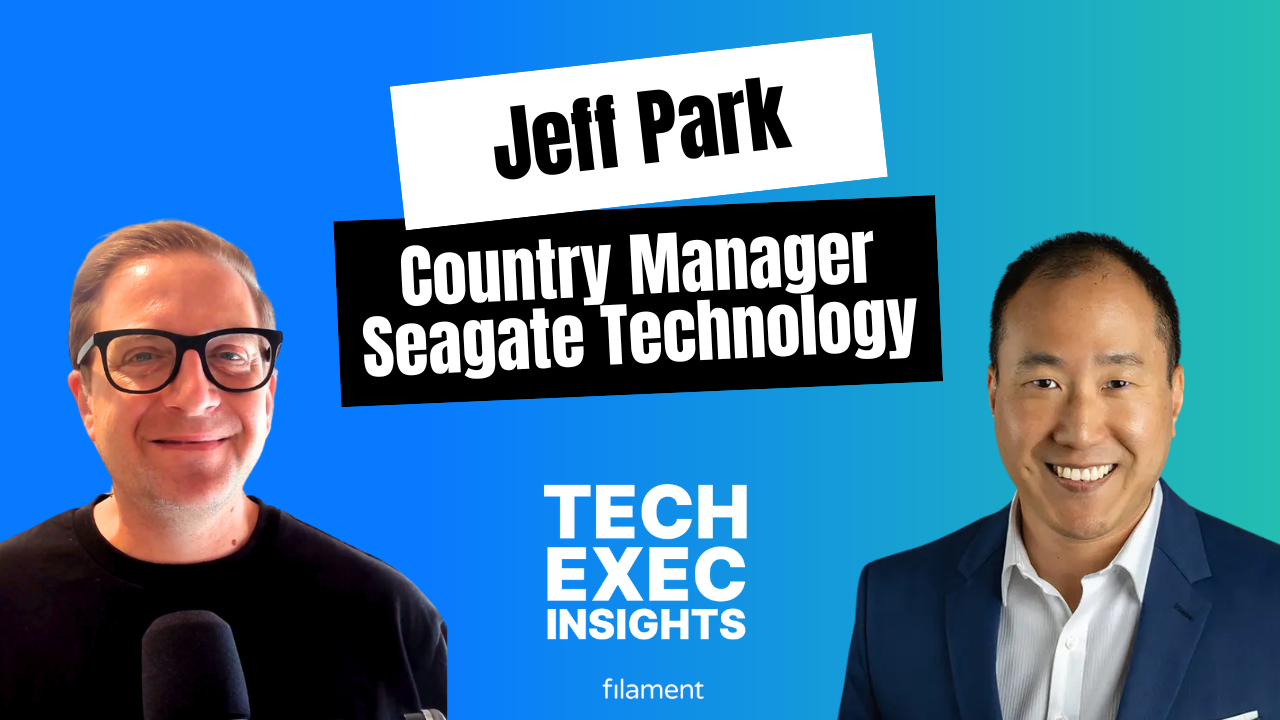
Storage has quietly become one of the most contested decisions in enterprise IT. The buying committee has expanded, the stakes have changed, and the old product-centric pitch no longer holds. Jeff Park, Country Manager Australia at Seagate Technology, frames the shift plainly: security is no longer optional, it is part of the infrastructure. In a conversation covering capacity scaling, buying committee dynamics, margin pressure, and partner strategy, Park outlines exactly where the channel needs to move in 2026. Watch the full conversation before reading further.
Seagate Technology is a global data storage company serving enterprise, cloud, and consumer markets. Its enterprise portfolio covers high-capacity hard drives, storage systems, and data management solutions designed for scale, security, and efficiency. With AI infrastructure investment accelerating across Australian enterprises, Seagate’s position in the channel ecosystem makes Park’s perspective directly relevant to technology partners navigating this shift.
Capacity Without Compromise
The pressure on enterprise storage is no longer theoretical. AI workloads demand more capacity, and most organisations are not ready to re-architect their entire infrastructure to accommodate growth. Seagate’s response has been to increase storage density without expanding physical footprint or driving up power consumption.
“You have a more robust scalability platform to grow as your demand grows.”
That is a practical answer to a real constraint. Organisations are not going to rebuild their data centres every time AI adoption accelerates. The platforms that scale within existing boundaries win the evaluation. For partners, that is a conversation about lifecycle planning, not just specs.
Buying Committees Have Changed the Conversation
The days of a single IT leader signing off on a storage purchase are over. Park describes what partners are now dealing with across the table: security teams asking about recoverability and risk, finance teams scrutinising investment lifecycle, and executives focused on business continuity and AI readiness.
“Storage is no longer determined by a single IT leader. You have to relay these messages to the finance and security and business stakeholders so they understand what is required.”
The implication for partners is direct. A product-led pitch delivered to a technical audience does not close a multi-stakeholder deal. The conversation has to shift to outcomes. Partners who cannot translate infrastructure decisions into the language of risk, cost, and continuity will find themselves locked out earlier in the process.
AI-Ready Infrastructure as a Differentiator
Park’s advice to partners building their strategy right now is specific. Invest in AI-ready data infrastructure expertise, with a focus on on-premises and hybrid storage architectures. The reasoning is straightforward: while AI adoption is moving fast, enterprise sensitivity around customer data means most organisations will not push everything to public cloud.
“A partner who understands how to design high-capacity efficient storage architecture and integrate it with security and recovery into AI workflows, and help customers balance performance, cost, and sovereignty requirements, will come out strong for many years to come.”
That is not a generalised call to upskill. It is a specific capability gap that exists right now in the Australian channel, where most partners are still responding to AI conversations reactively rather than leading them.
Margin Pressure Is Not Going Away
Partners competing on price and basic fulfilment are in a shrinking market. Park does not soften this: “The margin pressure is real and it’s not going to go away.”
The partners who come out of 2026 in a stronger position will be those who attach services and expertise to infrastructure, position storage as a strategic layer, and earn a trusted advisor relationship with customers. Seagate’s partner program, Park explains, has been redesigned to reward capability investment and customer outcomes rather than transaction volume alone.
The distinction matters. Volume-based incentives reward behaviour that accelerates commoditisation. Capability-based incentives reward the kind of specialisation that rebuilds margin.
How Filament Works with B2B Technology Organisations
The dynamics Park describes, expanding buying committees, outcome-based positioning, capability-led differentiation, are exactly what B2B technology marketing needs to reflect. Content and messaging that speaks only to technical buyers misses the conversation entirely. Filament works with technology organisations to align their go-to-market approach to the way enterprise buying decisions actually happen today. [LINK: relevant Filament service or capability page]
Talk to Jeremy
If the themes in this conversation are live issues in your business, a short strategy conversation is a practical next step. Jeremy Balius works with B2B technology organisations on their go-to-market positioning and content strategy. There is no pitch involved. Book a no-obligation conversation to work through where your current approach is aligned and where it is not. [LINK: Book a strategy conversation with Jeremy]