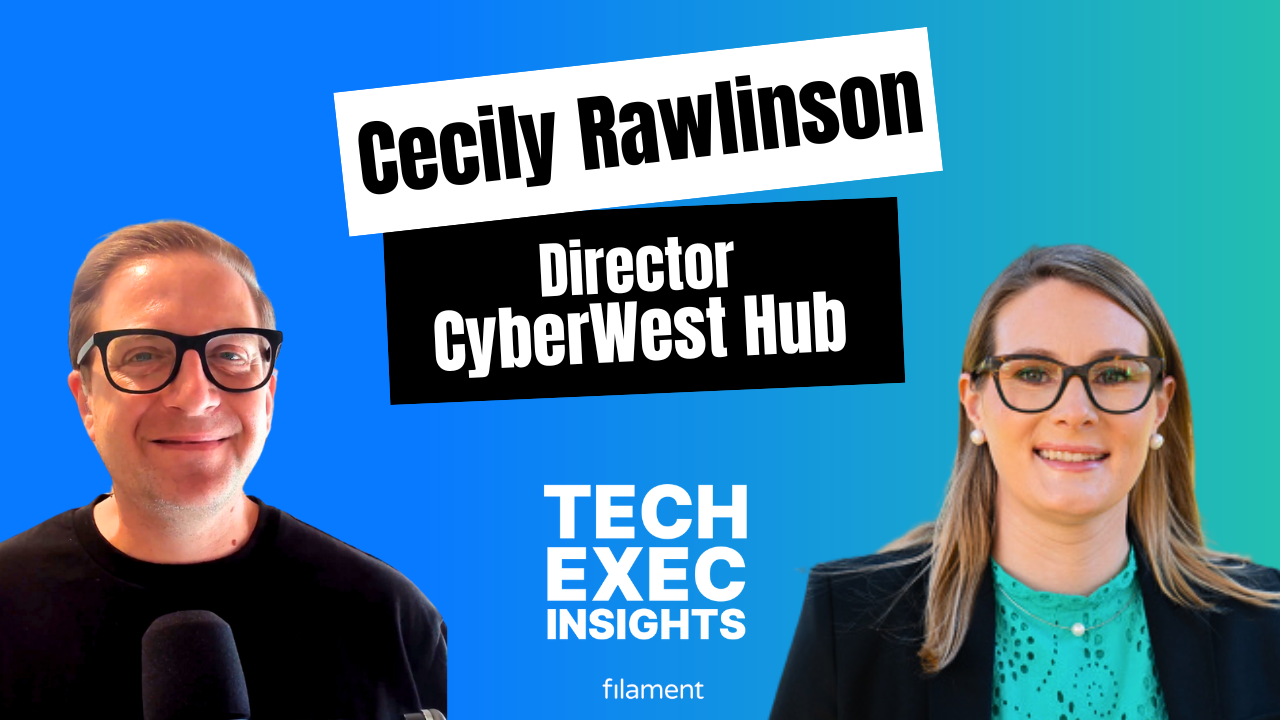
Introducing Cecily Rawlinson and Cyber West Hub
Most organisations still treat cybersecurity as a technical problem. Cecily Rawlinson thinks that framing is part of why they stay vulnerable.
Cecily Rawlinson is the Director of Cyber West Hub, the state government-funded innovation hub hosted by Edith Cowan University that sits at the centre of WA’s cybersecurity sector. In this conversation, she covers how the Hub supports founders and startups, why diversity of thought is a security asset, and what it will actually take to close the skills gap in WA. Watch the conversation before reading further.
Cyber West Hub started in 2021 with around 16 companies. It now works with over 83 cybersecurity startups, scale-ups, and small businesses across the state. The Hub connects those companies to government, industry, researchers at Edith Cowan University, and commercialisation expertise. It also runs community education programs, student pathways, and initiatives to grow the pipeline of cyber professionals in WA.
Watch the full Tech Exec Insights conversation
The problem with cyber language
One reason business leaders struggle to act on cyber risk is the language used to explain it.
Cecily’s view is direct: the technical complexity of cybersecurity has historically made it easier to sell, but harder to adopt. “Using plain business language to talk about cyber risk as just any other business risk you have to manage” is the shift she argues for. If a business already runs fire drills, the concept of incident response planning is not a stretch. But most executives have never heard it framed that way.
She draws a direct parallel to the evolution of occupational health and safety. OH&S was once seen as a cost centre with no clear ROI. Now it’s non-negotiable. Cyber is on the same trajectory. The question is whether leaders will wait for a forcing event or get ahead of it.
Procurement without a map
One practical gap the Hub identified early was how difficult it was for organisations to find and evaluate WA cybersecurity providers.
The WA Cyber Capability Directory, launched at the 2025 Cyber West Summit, addresses that directly. It functions as both a procurement tool and a communications asset, letting buyers filter by specialisation and see whether a provider is WA-based, interstate, or international.
An Education Directory runs alongside it, consolidating pathways from TAFEs and universities into one resource for students, career counsellors, and parents navigating an increasingly complex set of options.
Keep up to date with current directories from the Cyber West Hub website.
Diversity as a technical advantage
The Hub’s inclusion work is not separate from its security mission. It is part of it.
Cecily makes the case plainly: “If you’re building a survivor team on an island, you need people with different life experiences.” Cybersecurity threats are varied, the people being targeted are varied, and the teams defending against those threats should reflect that.
The Hub’s Cyber Queens program was built in response to attrition among female students in cyber degrees. In classes of 20 to 30 students, a single female student in the room is common. The Hub created structured spaces to address that isolation. At the Cyber West Summit, 44 percent of speakers have been female since 2023.
The Hub also supports Warembo wa Cyber, a network for professional women of colour in cyber, piloted recently with strong uptake.
The argument is consistent: representation is not a soft initiative. It directly affects the capability of the sector.
What founders get wrong
For WA-based cyber startup founders, Cecily’s advice is less about product and more about communication. Too many founders default to technical language with buyers who are not technical. If the person making the purchasing decision does not understand what the product does in terms of their own operations, they will not buy it.
The reframe she recommends: position cybersecurity as a business enabler, not a blocker. Security teams that say no to everything are a known frustration inside organisations. Founders who can credibly say “here is a secure foundation that lets you do more” are addressing a real organisational tension.
How Filament Works With Security Providers and MSSPs on This
The communication gap Cecily describes throughout this conversation is one Filament works on directly with B2B technology companies. Translating technical capability into language that lands with buyers is not a marketing problem. It is a commercial one. Filament helps technology organisations build content and messaging strategies that close that gap.
Discover more about Filament’s Cybersecurity Marketing.
Ready to discuss your Go-to-Market?
If you work in or around the cybersecurity sector and want to think through how to position your capability with non-technical buyers, Jeremy Balius is worth a conversation.
Jeremy works directly with B2B technology businesses on strategy, positioning, and growth. No pitch. No agenda. A focused conversation on what you are working on and whether Filament can help.