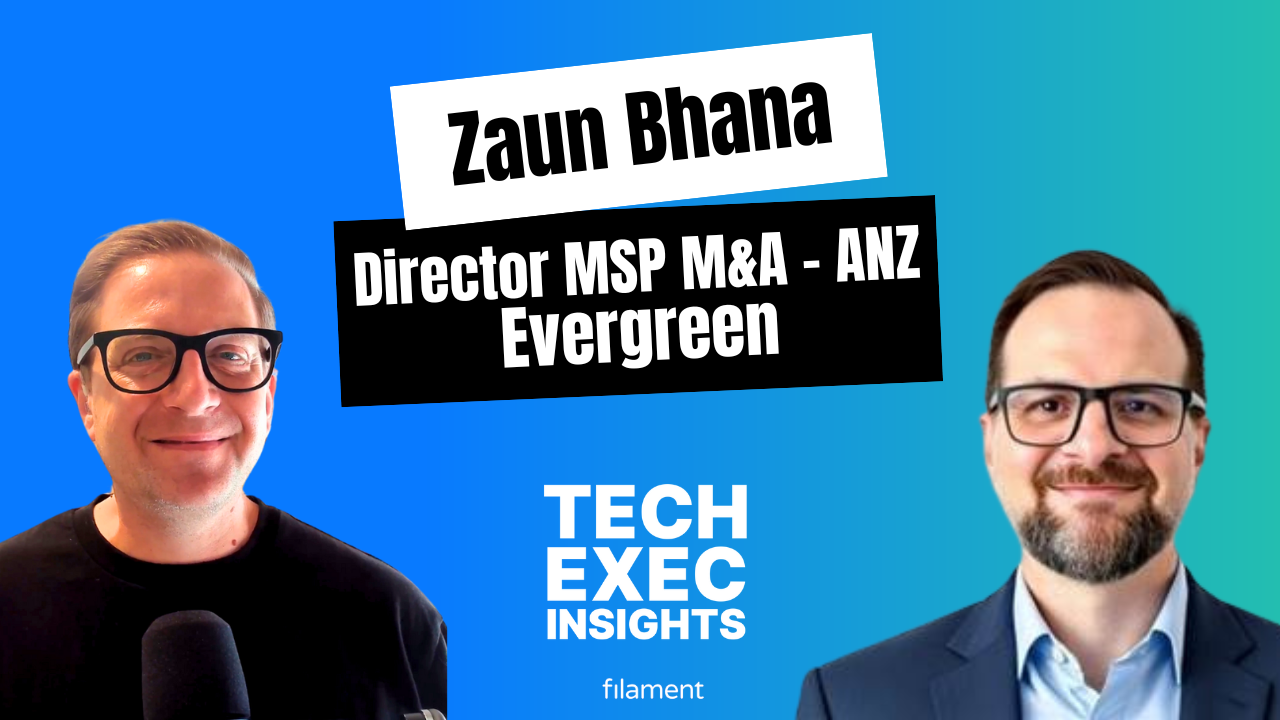
Introducing Zaun Bhana and Evergreen
Most MSP founders have no idea what their business is actually worth. That gap between assumed value and real market value is widening as M&A activity in the ANZ MSP sector accelerates. Zaun Bhana, Director of MSP M&A ANZ at Evergreen, has spent years on both sides of that conversation. He built and exited his own MSP, Leap Consulting, over 21 years. Now he helps other founders navigate the same decisions. This conversation cuts through the noise on valuations, exit readiness, and what the current consolidation wave actually means for MSPs across the region. Watch the full interview before reading further.
Evergreen is a permanent capital buyer of managed service providers. Unlike private equity, it does not operate on a fixed exit timeline.
Its model centres on decentralisation: acquired MSPs retain their brand, culture, staff, systems, and leadership. With over 100 MSPs in its portfolio across North America, Australia, and New Zealand, Evergreen provides shared benchmarks, best-practice playbooks, and purchasing scale while each business continues to run independently.
Watch the full Tech Exec Insights conversation
3 Forces Reshaping the ANZ MSP Market
Bhana identifies three converging pressures that are changing the MSP landscape right now.
1) Demographic
The first is demographic. Baby boomer business owners are exiting, and the MSPs serving them are losing clients through no fault of their own. Businesses are being sold, merged, or folded. That churn is accelerating as economic pressure mounts across the region.
2) M&A
The second is M&A from outside the sector. Accountants, consulting firms, marketing agencies, and AI companies are moving into the MSP space. New capital is arriving from overseas investors, search funds, and platform aggregators. Bhana puts it plainly: there are now far more buyers than sellers in the market. That imbalance is pushing multiples higher than most founders expected.
3) AI
The third is AI. For MSPs that have already navigated cloud, mobile, cyber, and broadband, AI represents another inflection point. Some see the opportunity. Others, particularly those running 20- to 30-year-old businesses, are asking whether they want to go through another technology cycle. Bhana notes this is producing a new cohort he describes as “AI native MSPs”, a term that reflects how fundamentally the entry point into the market has changed.
What Actually Drives a Premium Multiple
When Evergreen assesses an MSP, three metrics matter most.
1) Profitability
The first is profitability. Top-quartile MSPs in ANZ run at 18 to 20% EBITDA. The median sits around 10%. The bottom quarter is losing money. That gap matters because it is the clearest signal of how well a business is actually managed.
2) Recurring Revenue
The second is recurring revenue. A high percentage of labour-based managed recurring services indicates the business has moved beyond project work and built a mature model for onboarding, growing, and retaining managed services clients.
3) Owner Dependency
The third, and the one that separates good businesses from premium ones, is owner dependency. A business commanding a premium multiple can operate without the founder. Bhana is direct about this: “Can the business feed itself without the owner being there?” If the answer is no, the multiple reflects that. Founders who are still doing tickets, quoting work, or running projects after 20 years face a very different valuation conversation than those who have stepped back from day-to-day operations.
PE, Strategic Buyers, and the Evergreen Alternative
Bhana frames the three buyer types as different paths up the same mountain. Private equity moves fast, typically on three-to-five-year timeframes, with growth driven by further acquisition. That speed creates disruption. Staff and customers often absorb the impact.
Strategic buyers offer a different trade-off: a business that might not be large enough for a PE platform can find a home. The cost is often the brand and culture the founder built. Once integrated, the name, the team identity, and the operational independence tend to disappear.
Evergreen’s model sits outside both. With no fixed exit horizon, it retains the founding brand, existing leadership structure, and operational systems. Bhana says roughly 30% of cases have the founder continuing to run the business, 30% see a second-in-command step up, and 30% require finding a new CEO. In all cases, the MSP keeps its staff, its systems, and its identity.
Why Most Founders Are Not Ready
Bhana draws on his own experience selling Leap Consulting after 21 years. The lesson he returns to consistently is timing. Most founders start thinking about an exit far too late. He estimates 99% of MSP owners have never seriously modelled what their exit looks like.
The practical consequence is this: a founder who discovers their business is worth less than their retirement target with 90 days before they want to exit has no room to move. The same discovery five years out is a solvable problem. That gap between knowing and acting is where most value is either built or lost.
Bhana does not advocate for selling. He advocates for understanding what the options are, early enough that they actually remain options.
How Filament Works With MSPs on This
The conditions Bhana describes, competitive talent markets, undifferentiated brands, owner dependency, limited visibility in front of vendors and customers, are marketing and positioning problems as much as they are operational ones.
Filament works with B2B technology organisations to build the kind of market presence that supports both growth and long-term optionality. That means developing the brand, content, and demand generation that makes an MSP recognisable to the people who matter: staff, vendors, customers, and buyers.
Discover more about Filament’s Marketing for MSPs.
Ready to discuss your Go-to-Market?
If this conversation raised questions about where your MSP sits in the current market, it is worth spending an hour on it.
Jeremy Balius works directly with B2B technology businesses on strategy, positioning, and growth. No pitch. No agenda. A focused conversation on what you are working on and whether Filament can help.