
FUJIFILM CodeBlue Launched Managed DMARC when Microsoft, Google and Others Enforced Email Authentication
In February 2024, Google and Yahoo began enforcing email authentication for bulk senders. In April 2025, Microsoft confirmed Outlook would follow. For FUJIFILM CodeBlue’s customers, most of them on Microsoft 365, email that had always arrived could start landing in spam. Domains without DMARC stayed open to impersonation.
CodeBlue answered with Managed DMARC, a new service inside its managed IT offer. This case study covers the go-to-market Filament built for the launch: the service page, the brochure, the sales kit and the thought leadership behind them.
About FUJIFILM CodeBlue
FUJIFLM CodeBlue is one of New Zealand’s largest Managed Service Providers (MSPs). Founded in 2004, CodeBlue has been helping businesses across New Zealand get the support, technology and expertise they need to reach their digital transformation goals.
FUJIFLM CodeBlue has over 180 staff, six locations across New Zealand, and two dedicated IT service desk centres. CodeBlue provides Managed IT services, cyber security and cloud services, Modern Workplace, data protection, procurement and vCIO services.
The company joined the FUJIFILM Business Innovation family in 2020.

Industry: IT Services Company
Type: Managed Service Provider (MSP)
Offering: Managed IT services
Target Market: SMBs to Large Enterprise in New Zealand
Vendor Channels: Adobe, Citrix, Cloudian, Cofense, Dell, Eaton, ESET, Fortinet, HPE, HP, Jabra, Kaseya, Logitech, Microsoft, SentinelONE, SMX, Ubiquiti, Veeam, VMware
Filament Services Used:
- Go-to-Market Strategy
- Sales Enablement
- Content Marketing
- B2B Creative
- Partner Marketing
- HubSpot Services
Filament Solutions Used:
The Challenge: Making email authentication a buying decision for businesses that had never heard of DMARC
CodeBlue had identified a gap in the New Zealand market for a managed DMARC service. Most of its customers ran Microsoft 365 and assumed the built-in protection covered email. Microsoft 365 flags DMARC failures, but it does not enforce DMARC at the gateway.
The inbox providers forced the timing. Google and Yahoo required authentication for bulk senders from February 2024. In April 2025, Microsoft confirmed Outlook would apply similar requirements to high-volume senders from May 2025. For government agencies and their suppliers, the New Zealand Information Security Manual already called for SPF, DKIM and a DMARC policy of reject.
CodeBlue planned to upsell the service to existing customers and include it in the standard SLA for new ones. Both depended on buyers understanding a protocol most had never heard of.
The audience made that harder. Alongside IT managers, CodeBlue needed finance managers, business owners and board members to act, across seven sectors from legal and accounting firms to construction, property management and aged care, in businesses of 20 to 400 staff.

The Engagement: Enlisting the agency that had already built CodeBlue's service GTMs
CodeBlue brought Managed DMARC to Filament because Filament had already written the case for its email security portfolio. The Advanced Mail Filtering launch established the argument that Microsoft 365’s built-in protection leaves gaps a managed service closes. Managed DMARC needed the same argument, extended to a new gap: sender identity.
Filament knew CodeBlue’s segments, its brand, its sales team and the Microsoft 365 objection its account managers hear most. It also maintained the website the new service page would sit on. A new agency would have spent its first weeks learning what Filament already knew.
Filament co-founder Nick Horton scoped the launch around CodeBlue’s two sales motions: the upsell to existing customers and the SLA bundle for new ones. Every asset had to work for both, and for a reader who might sit on a board rather than in an IT team.
The Solution: Marketing and sales assets that explain DMARC to buyers who had never heard of it
Every asset makes the same case. The inbox providers now enforce email authentication, managing it by hand causes delivery failures, and CodeBlue can run it for you. CodeBlue Managed DMARC is powered by Valimail and sold under the CodeBlue brand, so every asset leads with CodeBlue.
A three-layer email security framework
Filament positioned Managed DMARC as the third layer of a multilayered defence. Microsoft 365’s Exchange Online Protection is layer one. Advanced Mail Filtering is layer two. Managed DMARC completes the stack by verifying sender identity. The same framework ties this launch back to Advanced Mail Filtering, so sales tell one story across both services.
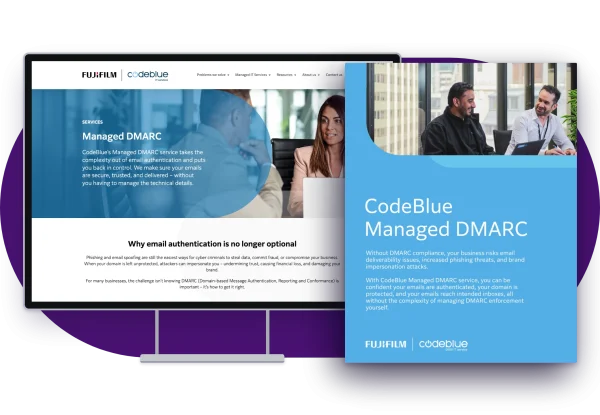
The Managed DMARC service page
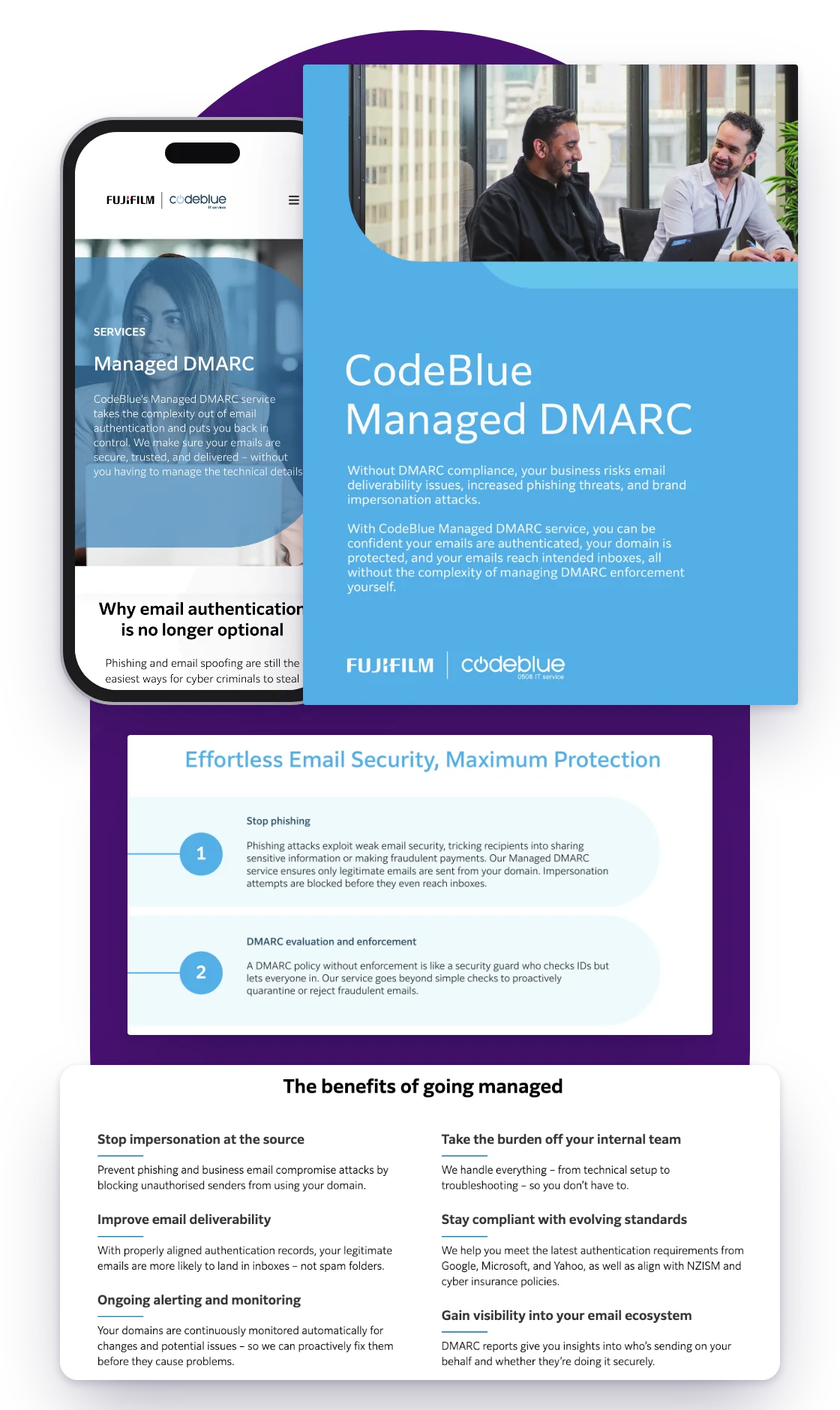
Filament built the Managed DMARC page in the Cyber Security section of codeblue.co.nz. It frames five problems buyers face, sets out six benefits of going managed, and answers nine technical questions on policy settings, alignment and DNS for the IT manager who checks the detail.
The Managed DMARC brochure
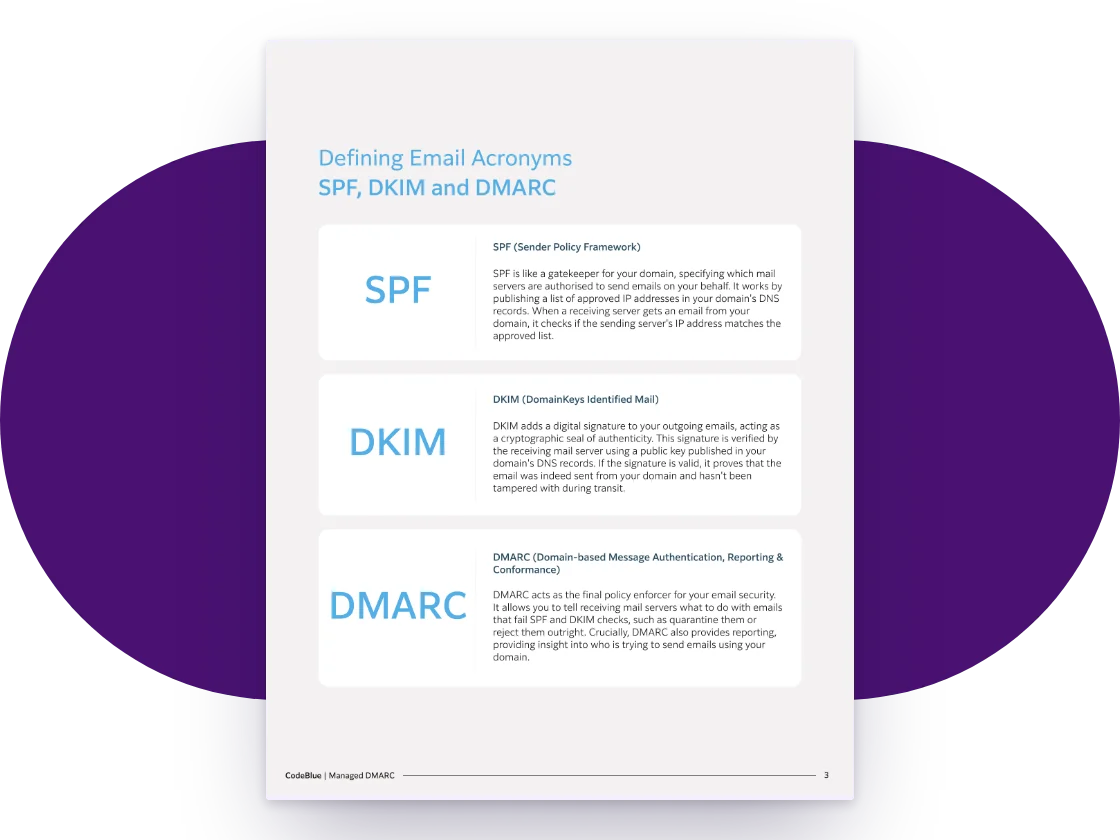
A six-page brochure for account managers to send after a first conversation. It defines SPF, DKIM and DMARC in plain language, sets out five service capabilities and six business benefits, and cites the NZISM sections that apply to government agencies and their suppliers.
The sales flyer and battlecard
A multilayered email security flyer gives account managers a leave-behind built on the three-layer framework. The battlecard gives them three lengths of service description, the service’s fit in the portfolio, target customers, and scripted answers to four objections, starting with “Doesn’t Microsoft provide all the protections we need?”
Thought leadership content
Filament wrote a long-form article for CodeBlue’s security leadership on what Google, Yahoo and Microsoft enforcement means for New Zealand businesses. The article tracked Microsoft’s position as it moved from expected to confirmed.
The Benefit: Marketing across two email security services
CodeBlue’s account managers can now sell email security as a single conversation.
Take the meeting where a finance manager says the business already has Microsoft 365. The account manager has a scripted answer to that objection, a flyer that shows where Microsoft’s protection stops, and a brochure that explains DMARC without asking the reader to learn DNS. If the customer has no advanced filtering, the framework makes Advanced Mail Filtering the next step. If they already have it, Managed DMARC completes the stack.
The service page covers the same ground for buyers who research first. A business owner can read the problem in commercial terms: fraud, failed deliverability, cyber insurance conditions. An IT manager can scroll to the FAQs and check how CodeBlue handles alignment and enforcement before booking a call.
Because the service sits inside the standard SLA for new customers, sales now raise email authentication in every new-business conversation, whether or not the customer asks.
The Result: Managed DMARC went live, with the sales kit to sell it
CodeBlue now sells Managed DMARC under its own brand as part of its Cyber Security portfolio, with customer-facing and sales assets built on the same argument as its existing email security service.
- A live service, maintained: the Managed DMARC page sits in the Cyber Security section of codeblue.co.nz, beside Advanced Mail Filtering. Filament maintains both.
- One framework, three layers: Microsoft 365, Advanced Mail Filtering and Managed DMARC now sell as a single email security story, carried by a brochure, a flyer and a battlecard.
- An ongoing engagement: across more than three years, CodeBlue has brought Filament its website, its Microsoft Copilot campaign, its Advanced Mail Filtering launch, this Managed DMARC and many other GTM campaigns and projects.
Are you looking to take a cybersecurity product or service to market?
Filament plans and runs vendor co-funded go-to-market campaigns for MSPs and cybersecurity providers, from the evidence base through to lead capture. Talk to us about cybersecurity marketing, or read our guide to accessing Market Development Funds.